Frequently Asked Questions
Clear, honest answers to the most common questions about the proposed solar development in Abbeyknockmoy & Monivea.
What is the proposed development?
Has the community been consulted?
I'm not a farmer - will this development affect me?
Will the solar power plant affect house prices?
Research from multiple independent, peer-reviewed studies consistently shows that utility-scale solar farms have measurable negative impacts on nearby residential property values. The key factors driving this include visual intrusion, the industrialisation of rural landscapes, increased construction traffic during development, and concerns about environmental and land-use risks. These effects are most pronounced within approximately 0.8 to 1.6 kilometres (0.5 to 1 mile) of the site but can influence the broader area's desirability and market value. An independent valuation by a local Chartered Surveyor and RICS Registered Valuer, an excerpt of which is on the planning file for application 26/61362, estimates depreciation in the region of 20 to 25% for a family home at the heart of the proposed Bellville development.
Notable studies documenting these negative impacts include:
- Virginia Tech's 2025 analysis found homes within 3 miles of utility-scale solar farms experienced an average value decrease of 4.8%, with properties within 0.5 miles experiencing up to 7.2% reductions. This comprehensive study analysed 8.8 million property sales across 3,699 solar sites in 40 US states and was published in the Proceedings of the National Academy of Sciences. (link, PNAS paper)
- Lawrence Berkeley National Laboratory (LBNL) 2023 study by Elmallah et al. identified average price reductions of 1.5% for properties within 0.5 miles of utility-scale solar farms, based on 1.8 million home transactions across six US states. Properties within 0.25 miles experienced 2.3% declines. (link)
- University of Rhode Island research (Gaur and Lang, 2020) documented property value declines of 1.7% within 1 mile of utility-scale solar projects, with homes within 0.1 miles (528 feet) experiencing 7% declines. This study analysed over 400,000 housing transactions around 208 utility-scale solar installations in Massachusetts and Rhode Island. (link)
- Dutch study by Dröes and Koster (2021) found a 2.6% decrease in house prices within 1 kilometre of solar farms, based on comprehensive national housing market data from the Netherlands covering 1985-2019. (link)
- UK analysis for Botley WestSolar Project estimated immediate losses of £153 million across properties within 1.5km, with individual properties closest to the solar farm losing £40,475 (detached), £27,145 (semi-detached), and £24,467 (terraced houses). The study noted that "the closer to a utility solar farm and the larger the installation, the greater is the adverse impact on house values." (link)
- Wisconsin analysis (2025) found homes within 0.5 miles of large-scale solar farms experienced 7.2% value reductions, with homes within 3 miles experiencing 4.8% reductions. Effects were negligible beyond 3 miles. (link)
The evidence consistently demonstrates that utility-scale solar developments create significant negative impacts on nearby residential property values, with effects most pronounced within the immediate vicinity and gradually diminishing with distance. The impacts are particularly severe in rural areas where solar installations alter the open space and rural character that contribute to property desirability.
For landowners, homebuyers, and policymakers, it is crucial to consider this robust evidence showing that utility-scale solar developments can negatively impact nearby residential property values. The industrialisation of rural landscapes and associated project effects affect not only homes directly adjacent to solar sites but often the wider community and market perception.
What impact will construction have on local residents and roads?
Heavy vehicles will increase traffic volumes, accelerating road wear and structural damage beyond the site boundaries, raising safety risks for motorists, pedestrians, and cyclists.
Due to shallow rock layers, drilling will likely be required to secure solar panel supports, causing considerable noise disturbance. Construction activity can also disturb local livestock, especially during sensitive periods like lambing and calving.
Why oppose solar power plants? Aren't renewables good?
Isn’t this solar power plant helping fight climate change?
How will this affect local farmers and food supply?
What alternatives do you propose?
Will covering farmland with solar panels harm bees and other pollinators?
Reference: Lec'hvien et al., 2025.
Do electromagnetic fields (EMFs) from solar installations affect pollinators?
Reference: Molina-Montenegro et al., 2023.
How drastic is the overall impact on pollinators in solar installations?
Reference: Lec'hvien et al., 2025.
Will the solar power plant create noise?
Can sheep realistically graze under or near the solar panels?
Are these projects permanent? Can the land be restored afterward?
What happens to the land after the solar power plant’s lease ends?
Industrial solar power plants are generally developed under long-term leases lasting around 35 years; these agreements typically cover the entire lifecycle of the project, including construction, operation, decommissioning, and land restoration. Although developers often commit to restoring the land to its original condition at the end of the lease, there is currently little to no long-term evidence demonstrating the effectiveness of such restoration efforts.
The installation and operation of solar projects can cause significant impacts, including soil compaction from heavy machinery, the presence of substantial infrastructure, and the potential use of chemicals, all of which may harm soil quality and local ecosystems. The processes involved in restoring land after solar farm operations cease are complex, expensive, and inherently uncertain, particularly where robust regulatory oversight and legally binding guarantees are lacking.
In addition, there is growing uncertainty within the solar energy sector. Recent developments, such as the potential cancellation of subsidies in major markets like the United States, underline the risk that financial and policy support for solar projects may diminish. If similar trends occur in Europe, projects such as the Bellville solar project could face premature abandonment, increasing the risk that sites are left unused or inadequately remediated.
Given the significant risks outlined, the future of the land after the solar power plant’s lease ends is a serious concern that demands immediate and ongoing scrutiny. Without strong, enforceable restoration guarantees and strict oversight, there is a real danger the land will remain degraded and unusable for farming or wildlife. This issue cannot be overlooked by anyone with a stake in the land’s long-term health and value.
How tall will the solar panels and structures be? Will they affect the local scenery?
Will the solar power plant affect local heritage or monuments?
Will the solar power plant be fenced off? What about security?
Will the solar power plant have nighttime lighting?
Are solar power plants dangerous?
Can a solar power plant fire be extinguished?
What are the risks associated with Battery Energy Storage Systems (BESS)?
These fires:
- Burn at extreme temperatures, often between 700°C and 1,000°C, and are nearly impossible to extinguish with standard firefighting methods
- Emit dense toxic smoke and contaminated water runoff, posing serious threats to people, livestock, and the environment
- Can reignite unpredictably days after initial suppression attempts
- Frequently result in road closures, resident evacuations, and long-term site contamination requiring extensive remediation
These risks are well documented internationally and must not be underestimated when siting BESS near homes or agricultural land.
How are BESS fires different from other industrial fires?
These complexities demand specialised emergency plans and resources that may not be fully in place at every rural BESS site.
Do Battery Energy Storage Systems (BESS) create noise?
Do Battery Energy Storage Systems (BESS) emit electromagnetic fields (EMF)?
What about evacuation zones for BESS fires?
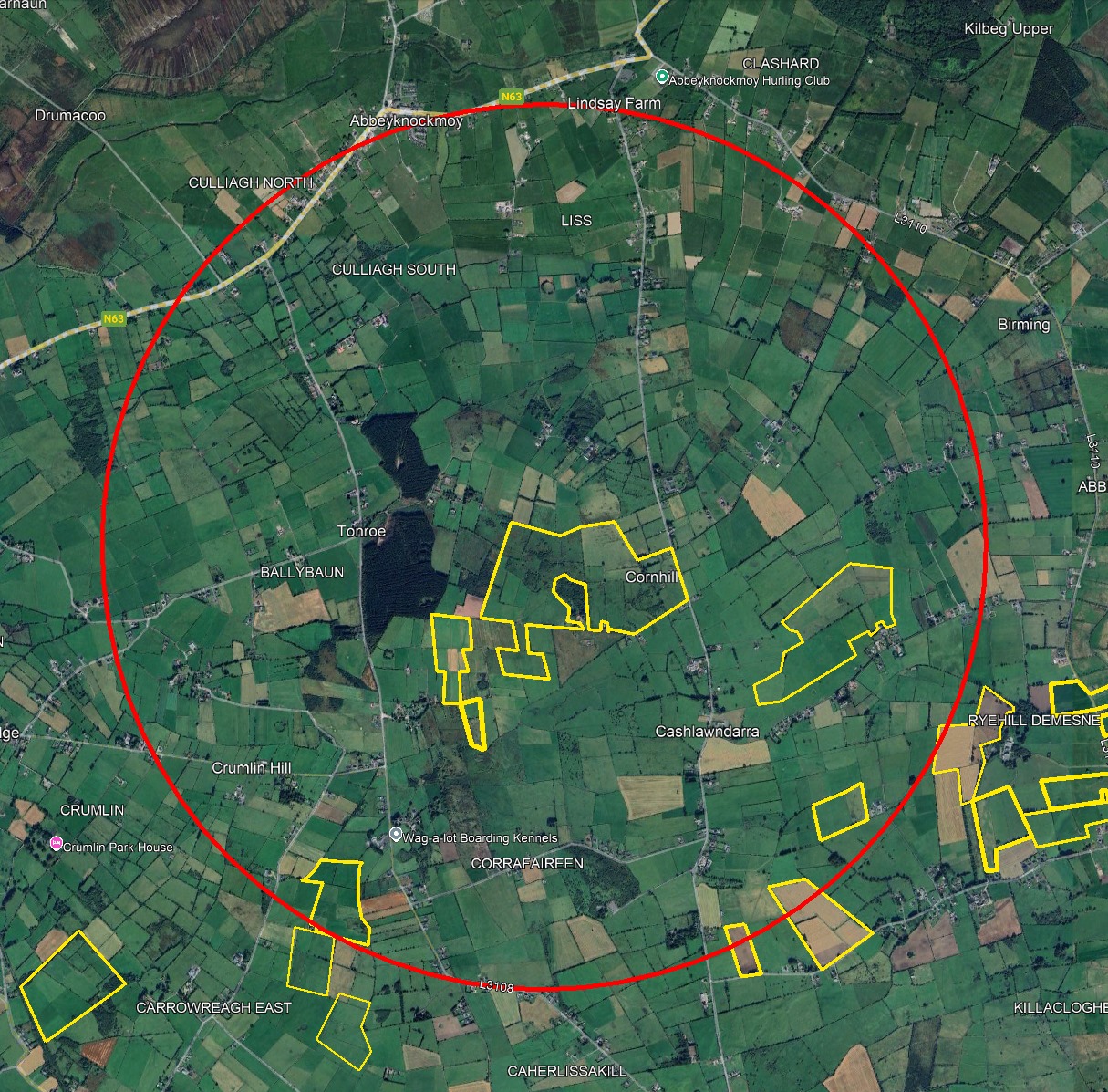
Veterinary expert Hugh Dillon, a partner at Troytown Equine Hospital, has highlighted the serious safety concerns associated with large BESS fires. He cites a 2025 incident at a 300MW lithium-ion battery storage fire in California where authorities ordered evacuation of an area covering 20 square kilometres. This example underscores the immense hazard posed by BESS fires due to toxic smoke, risk of explosion and extensive firefighting challenges that can endanger humans and livestock alike. Currently, Ireland has no dedicated safety regulator specifically overseeing lithium-ion battery installations, including those using Lithium Iron Phosphate technology, which raises concerns about emergency preparedness and the feasibility of such extensive evacuations.
For context, a 20 square kilometre area is shown via the red circle in the image below. It would stretch from Crumlin to Ryehill and from Abbeyknockmoy to Caherlissakill.
Reference: The Irish Field, “Bloodstock industry warned of threat from solar battery projects” (March 2025) - https://www.theirishfield.ie/bloodstock/news/bloodstock-industry-warned-of-threat-from-solar-battery-projects-860273